Commercial Cleaning
Warehouse and Industrial Cleaning in Melbourne
Maintaining safe, compliant, and efficient industrial spaces
A practical guide to warehouse and industrial cleaning in Melbourne, covering safety protocols, cleaning methods for different industrial environments, OH&S compliance, and scheduling around production operations.
Safety Requirements in Industrial Cleaning
Industrial cleaning operates in an entirely different risk environment from residential or commercial office cleaning. Warehouses and industrial facilities contain heavy machinery, forklift traffic, elevated storage, hazardous materials, and working conditions that require specific safety knowledge, personal protective equipment, and insurance coverage appropriate to the environment.
Every team member entering an industrial site must be equipped with mandatory personal protective equipment: high-visibility vest or clothing, steel-capped safety boots, safety glasses where required by site rules, hearing protection in noisy environments, and gloves appropriate to the materials being handled. These are non-negotiable requirements, not suggestions. WorkSafe Victoria regulations govern workplace safety in industrial environments, and both the facility operator and any contractors working on-site share responsibility for compliance.
Before beginning work in any Melbourne warehouse or factory, our team conducts a site-specific safety induction. This covers the facility's emergency procedures, the location of fire exits and assembly points, identification of forklift zones and traffic lanes, awareness of overhead cranes or automated systems, location of hazardous material storage, and any site-specific rules established by the facility operator. We treat every site induction seriously because industrial environments present genuine hazards that do not exist in other cleaning contexts.
Our industrial cleaning team carries public liability insurance and workers compensation coverage appropriate for industrial environments. Standard residential cleaning insurance is insufficient for warehouse and factory work. The risks are different, the potential claim values are higher, and insurers require specific coverage endorsements for industrial cleaning operations. When evaluating industrial cleaning providers for your Melbourne facility, verifying appropriate insurance coverage should be your first step.
We also maintain a comprehensive Safe Work Method Statement for industrial cleaning that covers every task our team performs in warehouse and factory environments. This SWMS identifies hazards associated with each task, the controls we implement to manage those hazards, and the emergency procedures relevant to each work activity. Facility managers can review our SWMS before we begin work, and we integrate our procedures with your site's existing safety management system.
For facilities storing or handling hazardous materials, including chemicals, flammable liquids, or biological materials, our cleaning protocols account for the specific risks these materials present. We carry appropriate spill containment equipment and know the procedures for managing accidental contact with hazardous substances during cleaning operations.
Industrial Cleaning Methods and Equipment
Industrial spaces demand cleaning methods and equipment that go well beyond what standard commercial cleaning delivers. The scale, the surface types, the contaminants, and the operational requirements are all fundamentally different.
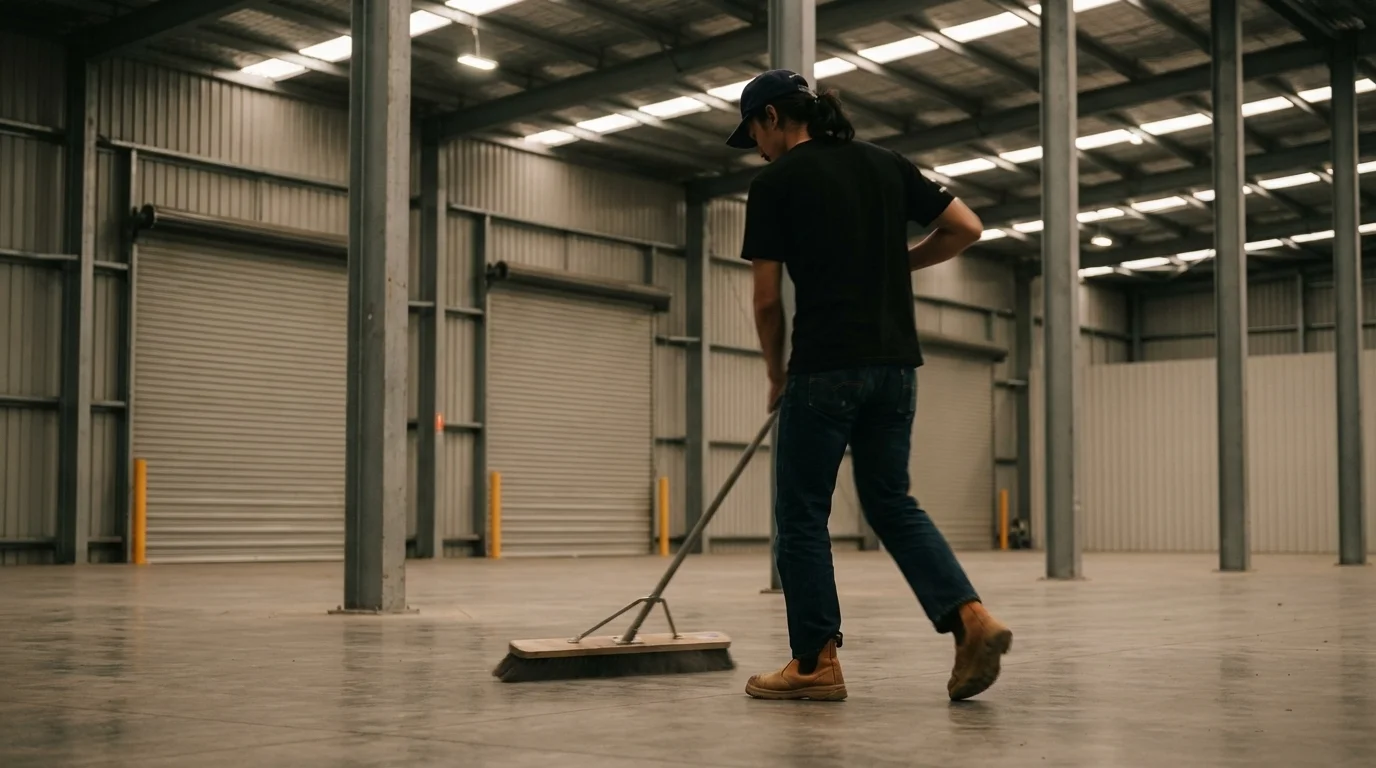
Floor cleaning in warehouses and factories is the foundation of industrial cleaning, and the method depends on the floor type, the contaminants present, and the area involved. For large open warehouse floors, ride-on floor scrubbers are the most efficient option, covering hundreds of square metres per hour with consistent results. These machines scrub, collect dirty water, and leave floors clean and nearly dry in a single pass. For smaller zones, around racking, near loading docks, and in areas where ride-on equipment cannot access, walk-behind scrubbers provide the same cleaning action in a more manoeuvrable package.
Degreasing is critical in facilities where oil, hydraulic fluid, food oils, or lubricants contact floor surfaces. Grease on industrial floors is not just unsightly but is a serious slip hazard and a common cause of workplace injury claims in Melbourne industrial facilities. We use industrial-grade degreasers specifically formulated for concrete and epoxy-coated floors, applied with appropriate dwell time and scrubbed mechanically to break the grease bond before extraction. For persistent oil staining in concrete, which is common in older Melbourne warehouses in suburbs like Laverton, Campbellfield, and Dandenong, we use specialised concrete degreasing treatments that draw oil from the porous surface.
High-pressure washing is the primary method for external areas, loading docks, car parks, waste compound areas, and any concrete surfaces exposed to weather and heavy use. Pressure washing removes accumulated grime, oil staining, tyre marks, and organic growth like algae and moss that develops on shaded surfaces, particularly during Melbourne's wetter months. For loading docks where food products are handled, regular pressure washing is often a condition of food safety compliance.
Dust suppression in warehouses and factories requires industrial-grade vacuum equipment with HEPA filtration. Fine dust from packaging, timber pallets, concrete wear, and product handling accumulates on all surfaces including racking, mezzanine floors, overhead structures, and ventilation systems. In environments where dust is a respiratory hazard, such as timber processing, metalworking, or food manufacturing, regular dust extraction is both an OH&S requirement and a practical necessity for equipment maintenance.
Spill management is both a cleaning task and a safety response. Chemical, oil, and food spills require immediate containment, appropriate absorbent application, careful removal, and surface cleaning. For facilities with specific spill response requirements under their environmental management plan, we coordinate our cleaning response with your established procedures and document our actions for your records.
Ready for a Spotless Space?
Get a free, no-obligation quote from Melbourne's trusted cleaning professionals.
Get a Free QuoteOH&S Compliance and Risk Management
A clean warehouse is measurably safer than a dirty one. The connection between facility cleanliness and workplace safety is direct, documented, and reflected in WorkSafe Victoria's approach to industrial facility inspections. Regular professional cleaning addresses several of the most common hazard categories in warehouse and factory environments.
Slip hazards from liquid spills, oil residue, and wet surfaces are among the most frequently cited safety concerns in Melbourne industrial facilities. Regular floor maintenance that includes degreasing, scrubbing, and prompt spill response directly reduces slip-related incident rates. For facilities with documented slip hazard histories, a professional cleaning regime with recorded maintenance schedules demonstrates proactive risk management during WorkSafe inspections.
Trip hazards from debris accumulation, including packing materials, broken pallets, loose strapping, and general waste, are addressed through regular housekeeping that is integral to a professional cleaning schedule. Our team removes accumulating debris as part of every maintenance visit, maintaining clear walkways, emergency exits, and forklift traffic lanes.
Respiratory risks from dust accumulation affect worker health over time and can trigger WorkSafe compliance notices in facilities where dust levels exceed exposure standards. Regular dust extraction from floors, racking, overhead structures, and ventilation systems reduces airborne particulate levels and demonstrates compliance with atmospheric monitoring requirements.
Fire risk in industrial facilities is directly influenced by housekeeping standards. Accumulated dust, waste materials, and combustible debris increase fire load and can impede access to fire suppression equipment. Fire safety inspections in Melbourne industrial facilities assess housekeeping standards as part of their evaluation, and a clean facility reduces both the probability and potential severity of fire incidents.
We provide cleaning schedules aligned with your facility's OH&S management plan and can participate in safety committee meetings and audit processes as needed. Our documentation includes dated cleaning records, photographic evidence of completed work where required, and incident reports for any safety concerns identified during cleaning operations. This documentation integrates with your existing safety management system and provides the evidence trail that WorkSafe Victoria expects to see during facility inspections.
For Melbourne industrial facility managers responsible for safety compliance, engaging a professional cleaning service with documented procedures, trained staff, and appropriate insurance is a risk management decision as much as a cleanliness decision. The cost of regular professional cleaning is modest compared to the cost of a single workplace injury claim, a WorkSafe improvement notice, or the reputational damage of a serious incident linked to inadequate housekeeping.
Scheduling Industrial Cleans Around Operations
One of the most important practical considerations for warehouse and factory cleaning is scheduling. Production cannot stop for cleaning, and cleaning cannot be effective if it constantly conflicts with operational activity. The solution lies in flexible scheduling that works around your facility's rhythm rather than against it.
After-hours cleaning is the most common arrangement for Melbourne warehouses and factories that operate during standard business hours. Our team arrives after the day shift ends and completes maintenance cleaning while the facility is unoccupied. This allows unrestricted access to all areas, eliminates the safety complications of cleaning around active forklift traffic and machinery, and means the facility is clean and ready when the next shift arrives.
Weekend cleaning works well for facilities that operate Monday through Friday but need more intensive work than after-hours sessions allow. A Saturday cleaning session provides extended time for deep cleaning, high-pressure washing, and intensive floor treatment without any operational conflict. Many of our Melbourne industrial clients schedule monthly Saturday deep cleans in addition to weekly after-hours maintenance.
Shutdown cleaning during planned maintenance periods is an opportunity for comprehensive cleaning that cannot be performed during normal operations. When a facility shuts down for equipment maintenance, stocktake, or holiday periods, the cleaning scope can extend to overhead structures, racking systems, behind fixed equipment, inside plant rooms, and any areas that are normally inaccessible during operations. We recommend coordinating shutdown cleaning schedules at least four weeks in advance to ensure crew availability during these high-demand periods.
Zone-based cleaning is the approach for facilities that cannot close entirely for cleaning. Working in designated zones while operations continue in other areas allows progressive cleaning across the entire facility without requiring a complete shutdown. This approach requires careful coordination with your operations team, clear delineation of cleaning zones with appropriate barriers, and awareness of traffic flow patterns. Our team is experienced in working within active industrial environments and understands the protocols required.
For Melbourne warehouses and factories, we recommend a tiered cleaning schedule. Weekly maintenance cleaning covers floors, amenities, waste removal, and high-touch surfaces. Monthly enhanced cleaning adds detailed attention to loading docks, external areas, and higher surfaces. Quarterly deep cleaning addresses overhead structures, racking systems, plant rooms, and the accumulated grime that maintenance cleaning does not reach. This tiered approach keeps the facility consistently clean, safe, and compliant without requiring disruptive deep cleans that take the facility offline.
The specific schedule that works best depends on your facility type, the products you handle, your operating hours, and your compliance requirements. We visit the site, discuss your needs with your operations and safety managers, and develop a cleaning plan that delivers the results you need within the practical constraints of your business.
Book a Free Consultation
Speak with our team about your cleaning needs, we'll tailor a solution for your space.
Schedule a Call