Commercial Cleaning
Medical Facility Cleaning Standards in Melbourne
Meeting healthcare cleaning compliance in Victorian medical practices
A comprehensive guide to healthcare cleaning standards for Melbourne medical facilities, covering infection control protocols, Victorian compliance requirements, risk-zone cleaning, and documentation for accreditation.
Understanding the Regulatory Framework
Medical facility cleaning in Victoria operates within a layered regulatory framework that goes well beyond ordinary commercial cleaning requirements. The stakes are fundamentally different. In a home or office, an inadequate clean means dust and untidiness. In a medical facility, an inadequate clean can mean healthcare-associated infection, patient harm, and serious legal consequences.
The primary Australian Standard governing medical facility cleaning is AS/NZS 4187, which covers the reprocessing of reusable medical devices and establishes the foundation for infection control in healthcare settings. The Australian Guidelines for the Prevention and Control of Infection in Healthcare, published by the National Health and Medical Research Council, provides specific guidance on environmental cleaning in clinical settings. In Victoria, the Department of Health issues additional directives that apply to all registered healthcare facilities.
For general practices, the Royal Australian College of General Practitioners sets standards through its accreditation framework. RACGP Standards for General Practices include specific requirements for environmental cleaning, with practices required to demonstrate compliant cleaning protocols during accreditation assessments. These assessments examine not just whether cleaning is happening, but how it is documented, what products are used, how equipment is managed, and whether staff are appropriately trained.
Failure to meet these standards carries real consequences. Non-compliant cleaning can trigger accreditation conditions that restrict a practice's operations. Infection control incidents linked to environmental cleaning failures create liability exposure for practice owners and can result in WorkSafe Victoria investigations. In the most serious cases, regulatory action from the Australian Health Practitioner Regulation Agency can affect the registration of practitioners associated with the facility.
For Melbourne medical practices, pathology collection centres, dental surgeries, physiotherapy clinics, and specialist consulting rooms, understanding these requirements is essential to maintaining accreditation and protecting patients. The cleaning company you engage must understand these frameworks thoroughly, not as an add-on to their standard commercial cleaning, but as a fundamental part of how they train their staff, select their products, and structure their service.
Infection Control Cleaning Protocols
Infection control is the central purpose of medical facility cleaning. Every product selection, every technique, and every scheduling decision should be made through the lens of reducing infection transmission risk. This requires a structured approach that differs fundamentally from conventional commercial cleaning.
Product selection in medical environments is governed by the Therapeutic Goods Administration. Disinfectants used in healthcare settings must be TGA-listed and appropriate for the intended application. Hospital-grade disinfectants differ from household products in their spectrum of activity, meaning the range of pathogens they effectively eliminate, and their validated dwell times. Dwell time is the period a disinfectant must remain wet on a surface to achieve its stated antimicrobial effect. For many hospital-grade products, this is between one and ten minutes. Applying a disinfectant and immediately wiping it off renders it ineffective regardless of the product's capabilities.
Colour-coded cleaning equipment is a mandatory infection control measure that prevents cross-contamination between different areas of a medical facility. The standard colour-coding system uses different coloured cloths, mop heads, and buckets for different zones: one colour for clinical areas, another for bathrooms, another for kitchen and break areas, and another for general spaces. This prevents a cloth used to clean a treatment room sink from being used on a kitchen bench, eliminating a direct cross-contamination pathway.
Cleaning frequency in medical facilities follows a risk-based schedule rather than a simple daily routine. High-touch surfaces in clinical areas, including door handles, light switches, examination bed rails, treatment trolley surfaces, and computer keyboards, require cleaning and disinfection multiple times during operating hours. General surfaces like floors, walls, and furniture require daily cleaning with more frequent attention in high-traffic periods. A structured cleaning schedule documented in a cleaning log provides both accountability and compliance evidence.
The cleaning technique itself matters in medical environments. The one-direction wiping method, where surfaces are wiped in a single direction rather than in circular motions, prevents redistributing contamination across the surface. Clean-to-dirty sequencing, where cleaning proceeds from the least contaminated area to the most contaminated area within each room, reduces the risk of spreading pathogens. These techniques seem simple, but they require training and reinforcement to become consistent practice.
Spill management in medical settings follows a specific protocol. Blood and body fluid spills require immediate containment, application of a spill kit with granular absorbent, careful removal and disposal in clinical waste, and disinfection of the affected area with a TGA-listed product at appropriate concentration. Our team is trained in spill management protocols and carries appropriate materials for immediate response.
Questions? We're Here to Help
Call us directly or send through your details. We typically respond within 24 hours.
Contact UsCleaning Specialised Medical Spaces
Different zones within a medical facility present distinct cleaning requirements based on the activities performed and the infection risk they represent.
Treatment rooms and procedure rooms are classified as high-risk environments requiring the most rigorous cleaning protocols. Between patients, a terminal clean is performed that covers the examination bed including the bed frame, all horizontal surfaces within the treatment zone, the floor immediately surrounding the treatment area, any equipment used during the consultation, and all high-touch surfaces including door handles and light switches. This clean uses TGA-listed hospital-grade disinfectant with observed dwell time. For rooms where invasive procedures are performed, including minor surgical suites in Melbourne GP practices and specialist clinics, the cleaning protocol extends to walls within the splash zone and any ceiling-mounted equipment.
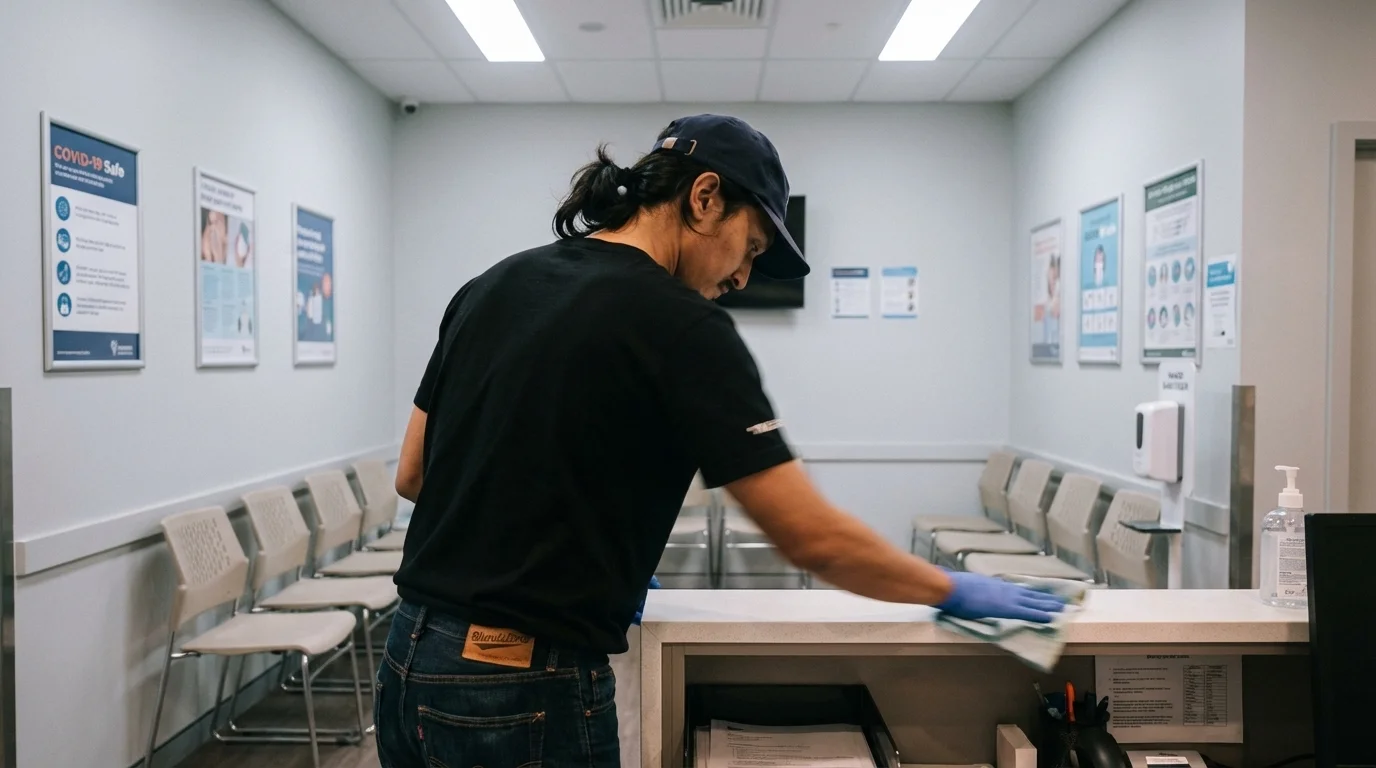
Waiting rooms and reception areas present a different challenge. These are moderate-risk areas where the primary concern is touchpoint contamination from patients presenting with infectious conditions. Chairs, reception counters, EFTPOS terminals, pens, magazines, and door handles all require regular sanitisation throughout operating hours. The frequency depends on patient volume, but for busy Melbourne practices seeing forty to sixty patients per day, touchpoint sanitisation every two to three hours during business hours is a reasonable baseline.
Pathology collection centres and specimen handling areas require biohazard-specific protocols. Surfaces that may contact blood or biological specimens require cleaning with products effective against blood-borne pathogens. Waste generated in these areas is classified as clinical waste requiring specialised handling, containment, and disposal through licensed clinical waste contractors. Our cleaning team understands the distinction between general waste, clinical waste, and sharps waste, and manages each stream appropriately.
Dental surgeries present unique cleaning challenges. Dental chairs, with their complex surfaces, articulating joints, and attached equipment, require careful cleaning that addresses every surface a patient or practitioner contacts. Suction system maintenance, including trap cleaning and line flushing, is typically the responsibility of the dental practice but should be coordinated with the cleaning schedule. Dental surgeries generate fine aerosols during procedures that settle on surfaces throughout the room, requiring thorough surface cleaning that addresses this distributed contamination.
Allied health practices including physiotherapy, chiropractic, and podiatry clinics have their own cleaning requirements. Treatment beds that contact patients' skin need disinfection between appointments. Rehabilitation equipment that is shared between patients needs cleaning after each use. These facilities may not require the full hospital-grade cleaning protocol of a medical practice, but infection control principles still apply and must be documented.
Documentation and Compliance Reporting
In healthcare cleaning, documentation is not administrative paperwork. It is clinical evidence. Without proper documentation, even the most thorough cleaning regime cannot be demonstrated to auditors, accreditation assessors, or in the event of an incident investigation.
Cleaning logs form the foundation of medical facility cleaning documentation. These logs record what was cleaned, when, by whom, and with what products. They are signed by the cleaner at the time of service and countersigned by a facility representative where required. For Melbourne medical practices undergoing RACGP accreditation, cleaning logs covering at least the previous three months should be available for assessor review. We provide standardised cleaning logs that align with accreditation documentation requirements and can be customised to match your practice's specific protocols.
Product safety data sheets for every cleaning product used in the facility must be maintained on-site and accessible to all staff. These sheets detail the product's composition, safe handling requirements, first aid measures, and environmental disposal instructions. Our product range comes with complete SDS documentation, and we maintain current sheets for every product in our medical facility cleaning kit.
Staff training records demonstrate that the people performing your facility's cleaning are competent to work in a healthcare environment. Training should cover infection control principles, colour-coded cleaning systems, correct disinfectant use including dwell times, spill management, waste classification and handling, and personal protective equipment use. We maintain documented training records for all team members who work in medical environments, including initial training completion and annual refresher participation.
Compliance certificates provide a summary statement confirming that cleaning services meet specified standards. We provide these for each facility we service, confirming our insurance status, our team's training credentials, our product compliance, and our adherence to the facility's cleaning protocol. These certificates are valuable during accreditation reviews and for practice managers who need to demonstrate oversight of cleaning services.
For Melbourne medical practices navigating the intersection of infection control, accreditation, and practical cleaning needs, the right cleaning partner simplifies compliance rather than complicating it. Our documentation is designed to integrate seamlessly with your existing quality management system, providing the evidence trail that accreditors expect without creating additional administrative burden for your practice team.
Choosing a Medical Facility Cleaning Service
Selecting a cleaning service for a medical facility is not the same decision as choosing a cleaner for an office or retail space. The compliance requirements, the risk profile, and the specialised knowledge required mean that standard commercial cleaning credentials are not sufficient.
When evaluating cleaning services for your Melbourne medical practice, verify that the company carries appropriate insurance including public liability and workers compensation. Confirm that their team members have completed infection control training specific to healthcare environments. Ask to see their cleaning protocols for medical facilities and check that these align with current guidelines. Request references from other medical practices they service in Melbourne.
Ask about their product range. A company using domestic cleaning products in a medical environment is not meeting compliance requirements regardless of how thoroughly they clean. Hospital-grade, TGA-listed disinfectants with documented efficacy against relevant pathogens are the minimum standard. Ask which products they use, what the validated dwell times are, and how they ensure dwell times are observed in practice.
Enquire about their approach to documentation. A company that provides detailed cleaning logs, staff training records, and compliance certificates as standard demonstrates that they understand the healthcare cleaning environment. A company that offers to clean your practice but cannot provide documentation is operating at a level below what medical facility compliance demands.
At Nusara, we approach medical facility cleaning with the same attention to detail and personal commitment that defines all our services. We understand that a medical practice's reputation rests partly on the cleanliness and professionalism of its environment, and that compliance is not optional. Our team is trained, our products are compliant, our documentation is thorough, and our service is consistent. For Melbourne medical practitioners looking for a cleaning partner they can trust with both the visible presentation and the invisible compliance requirements of their facility, we welcome the conversation.
Ready for a Spotless Space?
Get a free, no-obligation quote from Melbourne's trusted cleaning professionals.
Get a Free Quote